
A few weeks ago, we shared what a full year of Scholar looked like by the numbers: 241,879+ BaxterBot interactions and thousands of IEP and 504 accommodations delivered to the students who needed them most. That post answered the question of how much.
This one answers a better question: where, and how.
Because a number like 241,879 does not happen in the abstract. It happens in real buildings, in real classrooms, with real teachers who decided to try something and then made it part of how their school runs. So we went back to the schools that used Scholar this year and asked a simple thing: what did it actually look like for you?
What came back was not one story. It was many, and no two were the same. One school used Scholar to turn a stack of paper assessments into school-wide data. Another built it into the first five minutes of every history class. A third used it to challenge their highest achievers. The common thread was not the tool. It was teachers staying in charge and using Scholar to do the part of the job that never fit into a single day.
If you are new here: Scholar Education is the AI infrastructure for special education, built specifically for K-12 schools. BaxterBot gives every student 1:1 academic support inside the normal school day, adjusted to their reading level, accommodations, and language. PAWfessor Bruce handles planning, grading, and accommodation tracking so teachers get time back. It is COPPA-compliant, education-first AI built for classrooms, not a general-purpose tool pointed at one.
Here are five schools that showed what that can look like.
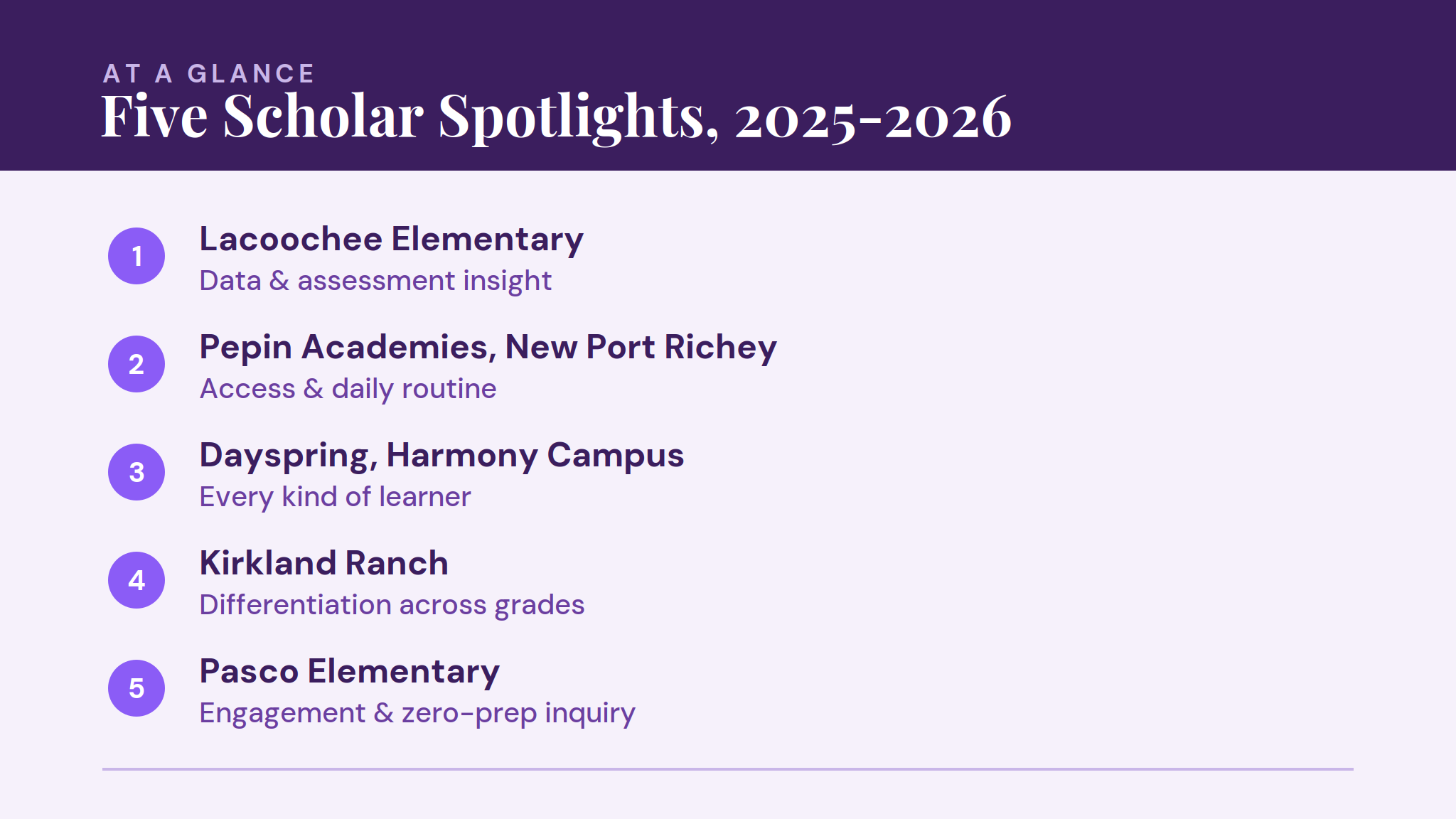
1. Lacoochee Elementary: Turning Paper Assessments Into School-Wide Data
K-5 | Pasco County | Use case: Data and assessment insight
At Lacoochee Elementary, a K-5 school in Pasco County, the question was not whether teachers were assessing students. It was that the assessments lived everywhere: on paper, in different formats, in different folders, impossible to see all at once.
Scholar pulled them into one place. The school moved paper-based and mixed-format assessments into a single digital platform, which meant that for the first time teachers, coaches, and administrators could see the data together, school-wide, instead of one classroom at a time. They ran pre and post assessments to measure real growth across the year, not just a snapshot.
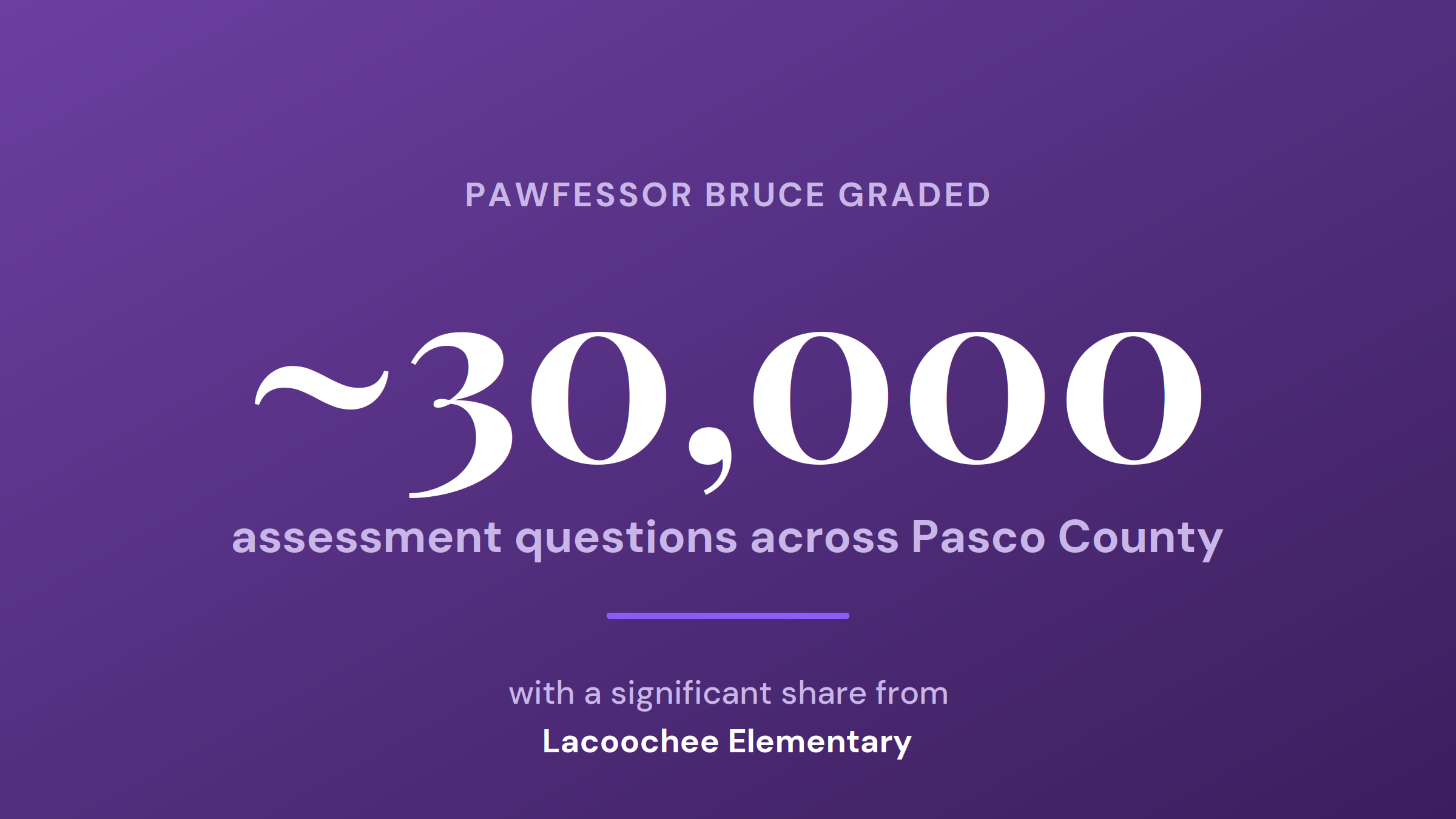
That kind of grading adds up fast, and it is exactly the work PAWfessor Bruce was built to absorb. Across Pasco County this year, PAWfessor Bruce graded nearly 30,000 assessment questions, with a significant share of that coming from Lacoochee. That is thousands of questions a teacher did not have to grade by hand, and thousands of data points a coach could finally act on.
2. Pepin Academies, New Port Richey: Access Built Into the Routine
Middle & high school | New Port Richey | Use case: Accessibility and daily routine
At the New Port Richey campus of Pepin Academies, Scholar was not an add-on. It was part of the culture.
In middle and high school classrooms focused on learning strategies and US and World History, students relied on BaxterBot for support during their assignments, in the moment they were working, not after. Class often started with an entrance ticket, a quick BaxterBot-guided warm-up that got students into the learning before the bell stopped ringing. It became a rhythm students could count on.
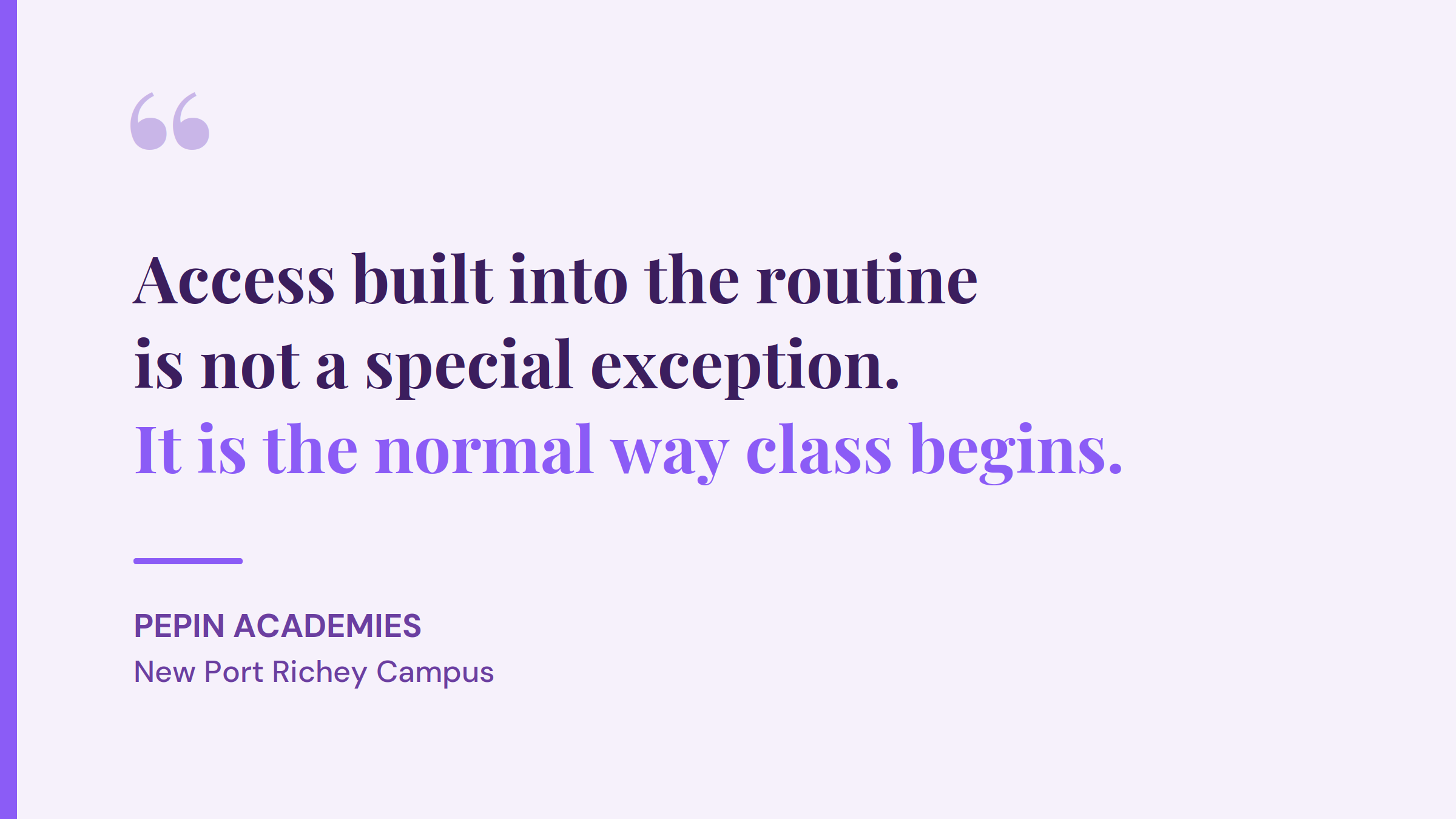
What made it work for every student was access. The accommodations students are entitled to on their IEPs and 504 plans, like text-to-speech and speech-to-text, were simply built into BaxterBot and delivered as part of the assignment, so reading and writing barriers did not stand between a student and the work. A student who used to wait for someone to read a passage aloud could simply start. That is what AI infrastructure for special education looks like in practice: the accommodation is not a special exception a teacher has to remember to arrange, it is already there, the normal way class begins.
3. Dayspring, Harmony Campus: Meeting Every Kind of Learner, Including the Ones Who Finish Early
K-5 | Harmony Campus | Use case: Reaching every learner, gifted to struggling
At the Harmony campus of Dayspring, a K-5 school, the goal was not to replace what was already working. It was to reach more of the students in the room.
Teachers folded Scholar into their existing curriculum and the resources they already trusted, using it alongside their instruction rather than on top of it. Students moved through Scholar lessons and worked with BaxterBot as they were ready, which gave the classroom room to stretch in both directions at once. The students who needed another pass at a concept got it. And the gifted and high-achieving students, the ones who finish early and ask “what now?”, got something harder to chew on instead of busywork.
That is the version of differentiation teachers actually want: not one path for the whole room, but a way to keep every learner challenged and supported at the same time, without writing five separate lesson plans to do it.
4. Kirkland Ranch: Differentiation Across Every Grade and Subject
K-8 | Pasco County | Use case: Differentiation at scale, ELL support, teacher workload
Kirkland Ranch is a K-8 school in Pasco County, which means the range of students in the building is enormous: a kindergartner learning letter sounds and an eighth grader working through algebra, under one roof.
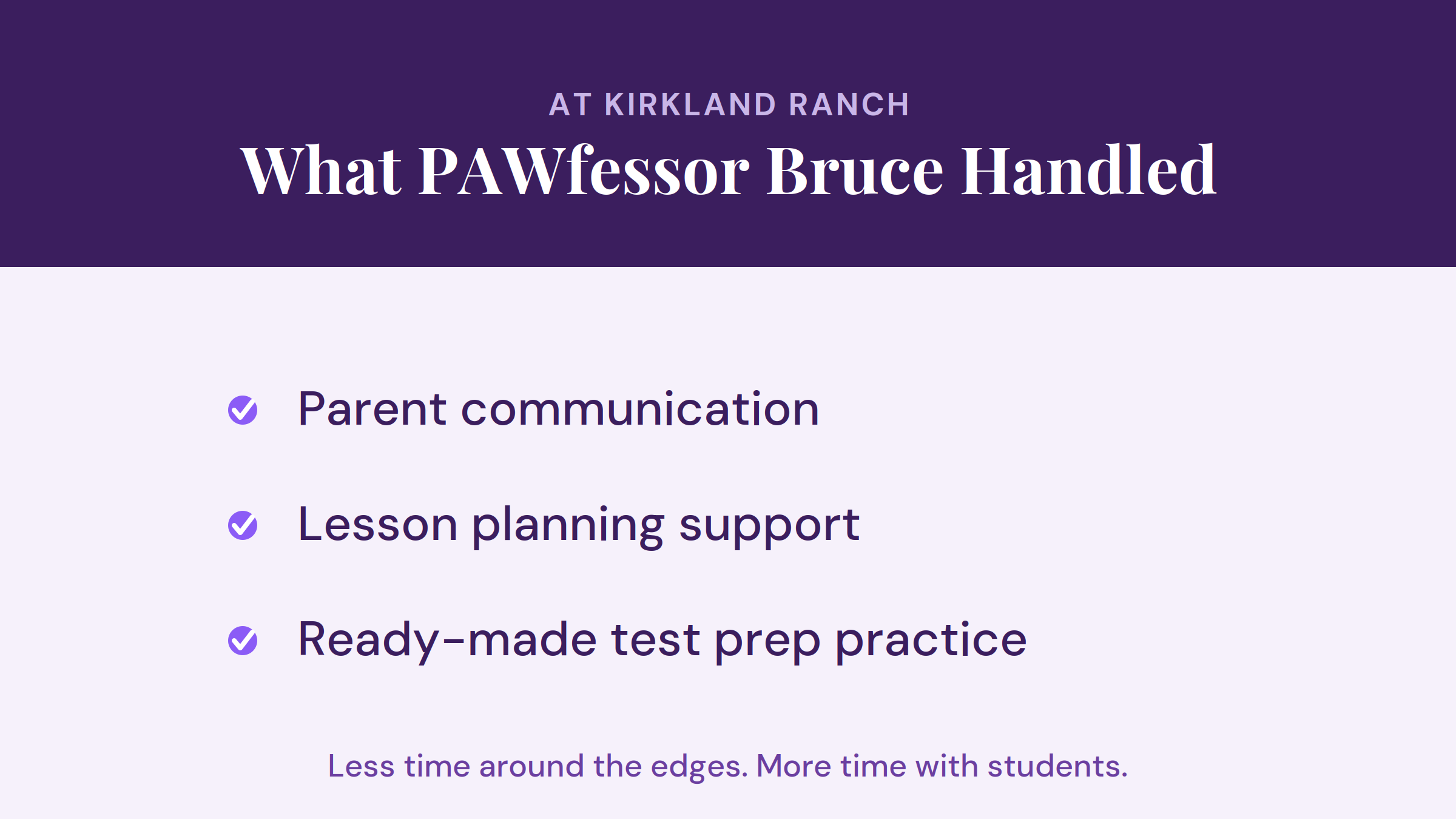
Scholar met that range. It supported a wide span of students, content areas, and grade levels, with instruction differentiated to fit and built to work with the materials teachers were already using. For English language learners, BaxterBot adjusted to language and reading level so those students could engage with the same content as their peers. And the Scholar library gave teachers ready-made test prep practice they did not have to build from scratch.
For teachers, the workload relief came from having PAWfessor Bruce always within reach. Need a hand drafting a parent message or shaping a lesson? Bruce was there for the quick ask, which meant less time on the around-the-edges work and more time with students. Across a school as wide-ranging as Kirkland Ranch, that adds up.
5. Pasco Elementary: Engagement and Zero-Prep Inquiry
K-5 | Pasco County | Use case: Student engagement and zero-prep inquiry
At Pasco Elementary, a K-5 school in Pasco County, teachers used Scholar to do something every elementary teacher wishes for: send students off to explore, with full support and zero prep.
Students used BaxterBot to dig into their learning and research the wider world, exploring cultures from around the globe with a guide that met them at their level the entire way. For the teacher, the prep was nothing. BaxterBot carried the support, scaffolding questions and keeping students moving, while the teacher worked the room. It is the kind of curiosity-driven learning that usually takes hours to plan, made possible without the hours.
It helped the school end the year on a high note, with students engaged and exploring right through to the finish.
What Ties Them Together
Five schools, five different starting points. One used Scholar for data, one for routine, one for challenge, one for differentiation across eight grade levels, one for engagement. None of them used it the same way.
But look closely and the same thing runs through all of them. In every building, the teacher stayed in charge. Scholar did not take over the classroom. It absorbed the heavy lifting around the edges: the grading, the data, the differentiation, the accommodations that have to reach the right student every time, the moment a teacher cannot be in two places at once. And in every building, the result was the same: more room for the human work that only a teacher can do.
That is what we mean when we call Scholar the AI infrastructure for special education. Not a novelty bolted onto the school day, but the layer underneath it, quietly making sure every student gets the support and accommodations they are owed, inside the normal school day, while teachers stay in control of the teaching. These five schools did not wait for someone to tell them what that could look like. They were already living it.
Here is to the teachers who tried something new this year, and to the students who showed us what it was for.
Want to See What This Looks Like in Your School?
Whether you are a teacher, an ESE or special education coordinator, or a school leader, this is what Scholar does all year long. BaxterBot gives students 1:1 academic support adjusted to their reading level and accommodations. PAWfessor Bruce handles planning, grading, and accommodation tracking so teachers get time back. IEP and 504 accommodations like text-to-speech get delivered automatically, while teachers stay in control of the instruction the whole way through.
You can see how Scholar works or bring Scholar to your school. We would love to show you what a full year could look like in your classrooms.