
We spent the last week of June in Orlando at ISTELive 26, and we brought the whole team, including Baxter and Bruce.
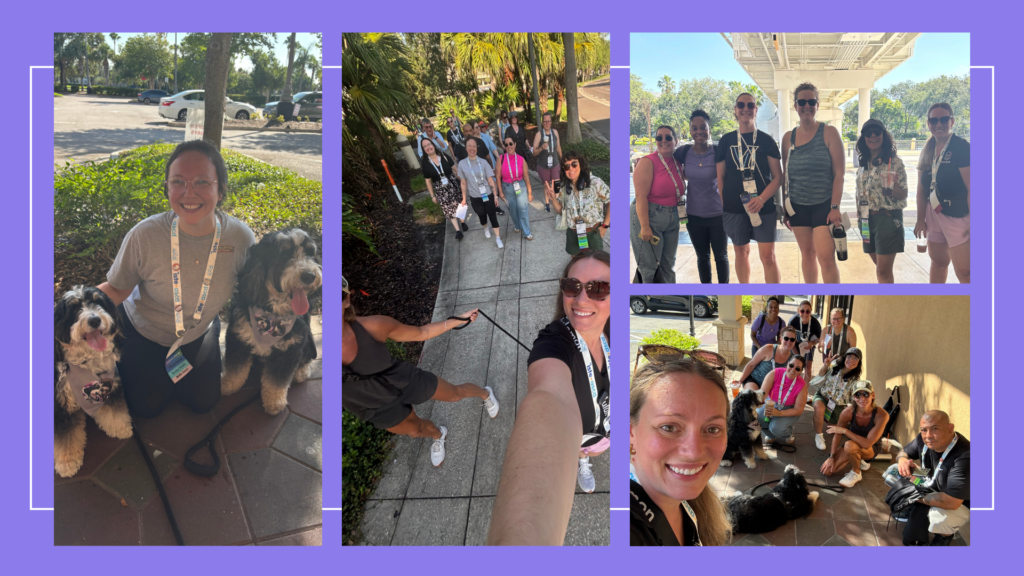
If you have never met them in person: Baxter and Bruce are the two dogs behind our student and teacher tools. They came along for a guided wellness walk we hosted called Paws on the Pavement, and they did their job well. They got a lot of pets. They also made it easy to have real conversations with educators about what is actually happening in their classrooms.
This is our recap. Not a rundown of every keynote, but the part that mattered most to us: what teachers and leaders are asking about AI right now, and the questions they brought straight to our booth about Scholar.
If you are searching for how AI is being used in special education, what “differentiation” really means in practice, or whether teachers stay in control when a school adopts an AI tool, these are the questions your peers were asking in Orlando.
The Themes We Heard in Every Room
A few ideas came up in nearly every session, from the main stage to the smallest breakout. They are worth naming because they signal where the field is heading.
AI is a tool, not the destination. Speaker after speaker made the same point: the technology is not the goal. Student learning is the goal, and the tool is only useful when it helps you get there. That framing has been our starting point from day one.
Keep the human in the lead. There was a deliberate shift in language this year. The old phrase was “human in the loop.” What educators and leaders landed on instead was “human in the lead.” The teacher directs the work. The tool does not.
Protect productive struggle. A shared worry ran through the sessions: that AI’s speed can rob students of the friction that learning actually requires. The best tools on the floor were the ones that withheld the answer on purpose and made students do the thinking. That is exactly how Baxter is built. He gives advice. He does not give the answer.
Quality over quantity. The conversation has moved past “how much screen time” toward “what kind.” Structured, purposeful use beats open-ended access. Not all screen time is equal, and educators are done pretending it is.
Bias and trust are non-negotiable, especially in special education. One of the sharpest sessions of the week focused on assistive technology and made a point we think about constantly: special education data often skews toward what a student cannot do, rather than what they can. Any AI built on that data inherits that bias. Building responsibly for these students means designing against it.
The Questions Educators Brought to Our Booth
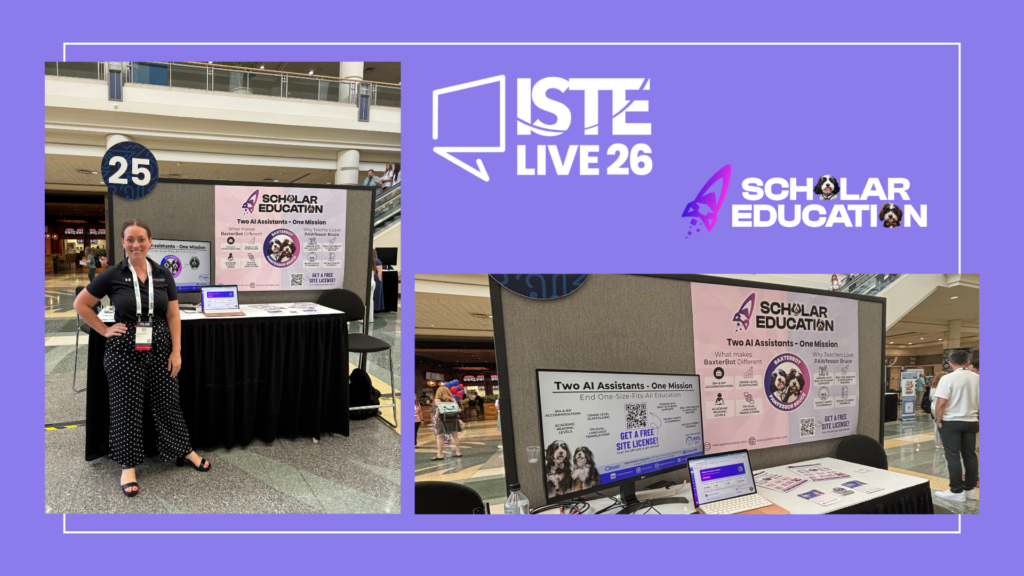
Here is the part we were most excited about. Between sessions and out on the walk, educators from across the country and around the world came to ask us specific questions about Scholar. These are the five we heard most, and our honest answers to each.
1. Are teachers in control? Can we bring in our own curriculum and resources?
Yes. This was the first question for a lot of people, and it is the right one to ask of any AI tool.
Scholar does not replace your curriculum or your judgment. You bring your standards, your lessons, and your materials, and the platform works inside them. PAWfessor Bruce handles planning, grading, and accommodation tracking so you get time back, but the instructional decisions stay yours. Baxter supports students in the moments you cannot be in two places at once. He does not take over the teaching.
The whole design assumes the teacher is in the lead. That is not a feature we added. It is the premise.
2. What is BaxterBot built on, and how does he tailor the learning?
Baxter is education-first AI built specifically for K-12, and he is COPPA-compliant. He is not a general-purpose chatbot with a school logo on it.
What makes him work is that he draws on each student’s learning profile: their reading level, their IEP and 504 accommodations, and their language needs. So when a student asks Baxter for help, the support that comes back is scaffolded to where that student actually is, not to a generic grade-level average. He adjusts to the reader in front of him.
3. What does differentiation actually mean inside Scholar?
This was the question that came up most at our poster session, Beyond Worksheets, and it is a fair one. “Differentiation” gets used loosely.
Inside Scholar, it is concrete. It means the same assignment can meet students at different reading levels. It means accommodations are delivered automatically instead of depending on whether a plan made it from the paperwork to the classroom. It means a student who needs a passage read aloud gets it read aloud, and a student who needs it in another language can get that too.
Differentiation here is not a setting you toggle on. It is how the platform behaves by default for every student on the roster.
4. Can learning be scaffolded for students working below grade level?
Yes, and this is where Baxter does some of his most important work.
For a student reading below grade level, Baxter scaffolds grade-level thinking without watering down the content. He breaks a task into smaller steps, checks for understanding along the way, and gives just enough support to reach the next step. The goal is to keep the student working on real, grade-level material with the right support underneath, rather than handing them an easier version and moving on.
5. I have a high population of ELLs. How can Scholar support them?
This came up again and again, and it is one of the clearest strengths of the platform. Scholar includes 179 dual-language translations for English language learners. A student can engage with a lesson in the language they think in while still building toward the English-language benchmark.
For an ELL student, that can be the difference between sitting on the sidelines of a lesson and actually taking part in it. It is the same access principle behind everything we build: meet the student where they are so they can move forward.
What We Took Home
Out on the walk, one theme kept surfacing that we did not prompt. Educators, especially special education teachers, talked about wanting students more involved in their own IEP goals: more self-advocacy, more frequent check-ins, more ways to make growth visible to the student over time.
We did not pitch that. They named it. And it maps directly onto why we built Scholar the way we did. When accommodations are delivered consistently and progress is visible, the student is not just the subject of a plan. They are part of it.
That is the throughline from every conversation we had in Orlando. The field is moving past flashy features toward tools grounded in sound teaching. It is moving past “AI saves teachers time” toward “time saved should go back into student learning.” And it is moving toward independence and access as the real point of all of this.
That is the ground we have been standing on since the first classroom. It was good to hear the rest of the field walking toward it.
Want to See What Baxter and Bruce Can Do?
You do not have to catch us at a conference. If you want to see how Scholar delivers accommodations, scaffolds grade-level work, and supports your ELL students inside your normal school day, reach out to our team to learn more!